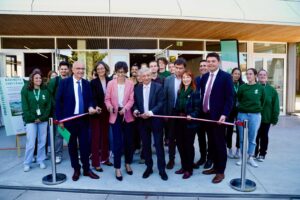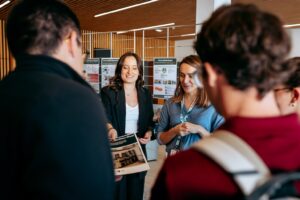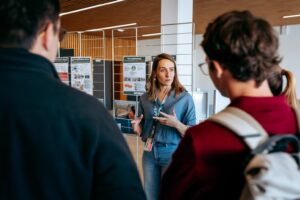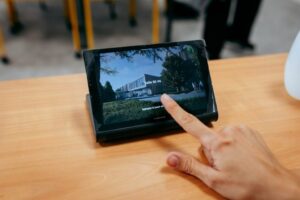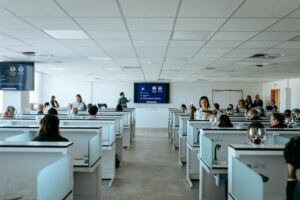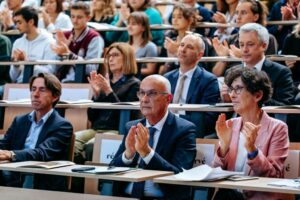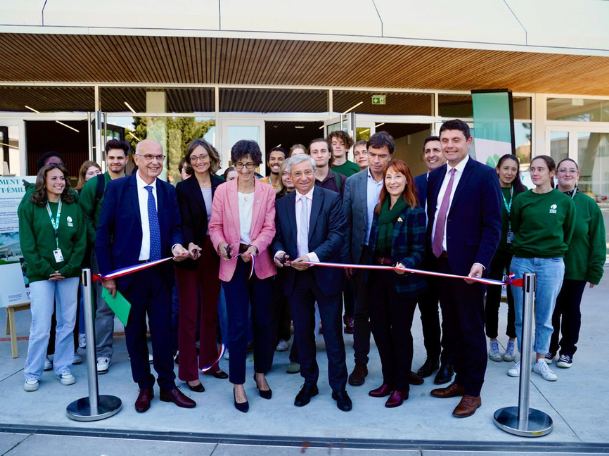
In the Demeter amphitheater, Sabine Brun-Rageul, director of the school, and Nathalie Rullaud, campus facilities manager, presented this large-scale project:
- an exemplary energy-efficient renovation (label upgraded from E to A, 80% energy savings)
- bio-based materials and innovative processes
- photovoltaic panels and a connected co-modal room
- a modular 300-seat amphitheater and redesigned living spaces.
These new spaces now house:
- the Sensolab, dedicated to sensory analysis and research into taste, smell, and texture,
- the FoodLab, a technology hall for food R&D,
- and hybrid teaching rooms open to new teaching methods.
The personalities present—Étienne Guyot (Prefect of the Nouvelle-Aquitaine region), Françoise Jeanson (Nouvelle-Aquitaine Region), Michel Labardin (Mayor of Gradignan), and Bernard Farges (Chairman of the Board) — praised the school’s commitment to providing an inspiring, sustainable, and forward-looking learning environment that is equal to the agroecological and societal challenges of today.
This project, launched in 2020, has received co-financing from the French government and the Nouvelle-Aquitaine region as part of the 2021-2027 State-Region Plan Contract (6.5 M€) and the Recovery Plan (5.6 M€) for the ecological transition of public buildings.
Awarded the Sustainable Development & Social Responsibility (DD&RS) label in 2025, Bordeaux Sciences Agro reaffirms, with Cœur d’école, its ambition: to train the agricultural engineers of tomorrow and support agricultural, food, and forestry transitions through innovative, sustainable infrastructure that is open to its partners.
“These places are more than just a symbol. They reflect our desire to reduce our environmental footprint, provide inspiring learning conditions, and develop innovative projects for our students and partners. Sabine Brun-Rageul, Director of Bordeaux Sciences Agro
Photos Les Focus d’Émilie
Photo coupe de ruban Préfecture de la région Nouvelle-Aquitaine