
Pierre Blondel defended his thesis on 19 December 2024 at the Institut des Sciences de la Vigne et du Vin. He worked in the INRAE-BxScAgro Vineyard Health and Agroecology research unit under the supervision of Brice Giffard, senior lecturer at BxScAgro.
His work has focused on assessing the effect of wine-growing practices such as the use of pesticides, copper contamination of soils and tillage of vine rows and inter-rows on the diversity of the mesofauna (microarthropods between 0.1 and 2 mm) and the activity of the microbial compartment in production plots.
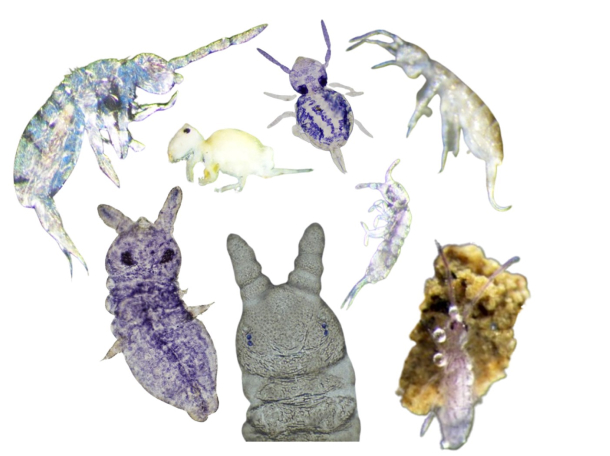
For the mesofauna in particular, he studied the effect of practices and the landscape environment on the diversity and abundance of springtails by sorting and identifying hundreds of individuals (illustration). These microarthropods, closely related to insects, can number several hundred individuals per m², with species adapted to life on the surface or deeper in the soil. Their role in the soil is more or less known, but they are detritivores and stimulate the activity of microorganisms by consuming them. In work carried out on the Bacchus site-workshop coordinated by Adrien Rusch (UMR Santé et Agroécologie du Vignoble), Pierre has shown that the most important factors explaining the diversity and abundance of these springtails are the level of organic matter, a fundamental resource for soil life, and the intensity of pesticide use. The diversity and abundance of these microarthropods increases when the soil in the plots is richer in organic matter and when the intensity of pesticide use in the plots is lower. In our data, we found no negative effect of soil copper contamination on Collembola diversity and a tendency towards a positive effect of tillage (fairly superficial in the plots studied): further research is needed to better understand the effects of soil compaction in vineyard inter-rows or of the different types of tools used on these communities.
Pierre measured the enzymatic activity of the microorganisms and once again showed that the level of organic matter was a major factor in explaining the activity response of microbial communities, more so than practices (organic or conventional farming, tillage or grassing).
Pierre’s work has been published twice, in the journal Applied Soil Ecology for the article on springtails: ‘Pesticide use and soil disturbance shape springtail communities in vineyards’ and in Pedobiologia for the article on the activity of microorganisms: ‘Organic matter content rather than farming practices modulates microbial activities in vineyard soils’.
To find out more:
- Blondel P, Joubard B, Rusch A, Giffard B (2024) Pesticide use and soil disturbance shape springtail communities in vineyards. Applied Soil Ecology, 105694. https://doi.org/10.1016/j.apsoil.2024.105694
- Blondel P, Fanin N, Joubard B, Milin S, Rusch A, Giffard B (2025) Organic matter content rather than practices modulates microbial activities in vineyard soils. Pedobiologia, 108 – 151017. https://doi.org/10.1016/j.pedobi.2024.151017
More information on the Bacchus network website : https://www.siteatelier-bacchus.com/
Financing :
This work was funded by the Conseil Interprofessionnel des Vins de Bordeaux between 2021 and 2024 (ENDLESS project) and Pierre Blondel’s PhD grant was co-financed by Bordeaux Sciences Agro. This project also involved researchers and technicians from another Bordeaux research unit, ISPA (Nicolas Fanin, Sylvie Milin). Benjamin Joubard (BxScAgro) supervised the field and laboratory measurements and supported Pierre Blondel’s work throughout the thesis.
Contacts :
- GIFFARD Brice
- Associate Professor
Unité SAVE :
https://www.linkedin.com/in/inrae-save/
https://sante-agroecologie-vignoble.bordeaux-aquitaine.hub.inrae.fr