Contributions :
Christopher Carcaillet (PSL Université), Guillaume Decocq (Université d’Amiens), Florian Delerue (Université de Bordeaux), Jean-Christophe Domec* (Bordeaux Sciences Agro), Jonathan Lenoir (CNRS), Richard Michalet (Université de Bordeaux)
Bordeaux Sciences Agro scientists are identified by an asterisk*.
Contact: Jean-Christophe Domec
Context :
It’s not just humans and animals that migrate. Trees also migrate naturally, at an estimated rate of a few kilometres per century. For thousands of years, plants have been shifting their range across continents in response to climate change. But given the speed of current climate change, this speed seems far too slow, since trees would have to move several hundred kilometres per century to cope with climate change.
The current acceleration in climate change is preventing these species from responding quickly enough, which is already having a negative impact on forest growth, response to disturbance, management and conservation. Assisted migration is one of the adaptation strategies chosen by the forestry industry to ensure that the species used for reforestation can guarantee the resilience of forest systems. Assisted migration consists of moving species to save them from extinction. The concept is applied in the context of global warming by planting tree species from hot or dry regions in place of trees from colder, wetter regions. In France, assisted migration means planting species from the southern Mediterranean, such as maritime pine from Portugal. Assisted migration is also often translocation, the term used to describe the action of moving species across natural barriers (mountains, seas), such as the Corsican laricio pine, the Atlas cedar from North Africa planted in the east of France, or Turkish firs planted in the Alps. This practice makes it possible to manage forests ahead of the effects of climate change by artificially accelerating forest adaptation in order to maintain timber production levels. Some people refer to this as a “socio-economic resilience of forestry”. There is nothing natural about this forced migration of tree species, which can cause environmental damage and potentially lead to climate change, as explained in this study of 106 tree species in Europe, North Africa and North America.
Approach :
Principal component analysis was used to analyse variation in 7 characteristics of 106 tree and tall shrub species from contrasting latitudinal distributions in western North America and Europe, in order to predict potential functional changes in forest ecosystems due to the transfer of tree species from low to high latitudes.
Conclusions and perspectives :
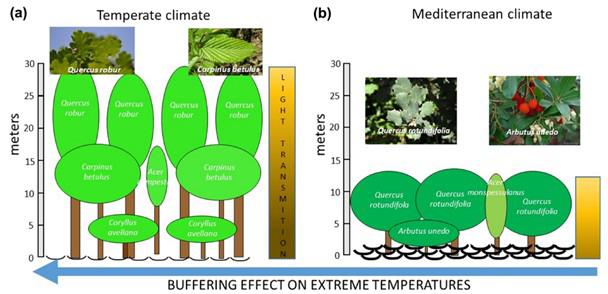
It emerges from this work that even if the basic idea is to do better to adapt our forests, the expected effects could be less beneficial. History has often shown that nature is not easily tamed; it must be understood. In hot, dry climates, adaptation to drought reduces tree height, and the leaves are often smaller, thicker and evergreen. The foliage of the dominant trees in a forest plays an essential role in buffering and attenuating – “cooling” – the effects of heat waves and drought. The less dense foliage of smaller trees from the south is less likely to mitigate climatic extremes. The undergrowth climate is warmer, drier and less buffered than that of the natural undergrowth of tree-dominated forests in temperate regions. If assisted migration were to spread over vast territories, this would worsen the energy balance at the atmosphere-canopy interface and could ultimately be detrimental to the fight against global warming. Assisted migration, and above all translocation, of species is therefore not a panacea. A change of forestry paradigm is needed, based on the original resources of the forests, facilitating their acclimatisation to the new climate rather than manipulating them too much, at the risk of further accelerating the process of global warming. Among the alternative solutions for avoiding runaway climate change, assisted “intra-specific” migration through “assisted gene flow” is preferable. This involves finding provenances, in the form of seeds, in warmer, drier regions, while remaining within the species’ native range, and introducing them in a mixture with more local provenances, thereby boosting genetic diversity.
Read all about it in the articles :
Assisted migration in a warmer and drier climate: less climate buffering capacity, less facilitation and more fires at temperate latitudes?